
Intrinsic Muscle Strength
Back in September of 2019 – which seems like an age ago as it was “pre-covid,” I wrote an article entitled “Why Do we need the intrinsic muscles of our foot?” Click here to recap.
Since then many more studies have been performed and many peer-reviewed scientific articles have been written about how important these muscles are and how effective exercises for ankle stability are in preventing falls.
Exercises for Ankle Stability can be Done with or Without Equipment.
In this article we will cover some of the equipment you can use to strengthen your ankles and also some exercises for ankle stability that you can do without equipment.
Equipment to Help You to Improve Your Balance and Speed up your Recovery
There are some exercises for ankle stability like we’ve mentioned that can go a long way towards recovery, but using some specially designed tools can be of great help.
The Foot Collective are dedicated to creating high-quality foot strengthening tools to help you to have strong feet for life and be less prone to injuries like ankle sprains.
They started as a small movement by Physical Therapist Nick St. Louis with the goal of:
(https://thefootcollective.com/pages/about-us 03/27/2025).

The TFC SoleMate Kit Includes:
✔ 1 x TFC SoleMate (Includes 1x Cork Mini Roller, 2x Cork Half Domes & 2 x Latex Toe Resistance Bands)
✔ 1 x Pair of Wild Toes (Toe Spreaders)
✔ 1 x Hacky Sack
✔ Training tutorials, routines & structured program
The kit is lightweight and portable.
Exciting New Evidence! Great News for patients with Chronic Ankle Instablility.
Performing targeted exercises for ankle stability for as little as 6 weeks can significantly improve the activation of these muscles in patients with chronic ankle instability.
In the “Journal of Exercise Rehabilitation,” authors Dong-Rour Lee and Young-Eun Choi found:
After 6 weeks of intervention, the abductor hallucis, flexor digitorum brevis, flexor hallucis brevis, and quadratus plantae all showed increased activation.
and
Our study results suggest that an IFM exercise program using toe posture provides foot stability in patients with CAI by improving the functions and dynamic balance of IFM
Note: IFM = Intrinsic Foot Muscles and CAI = Chronic Ankle Instability.
To determine their findings the examiners found 30 people with chronic ankle instability and had them perform a star excursion test, which is an established accurate test of CAI.
This means that we now have a great new tool to help us in the rehabilitation of people who have chronic ankle instability, whether it’s caused by playing sport, having hypermobile joints, or being of a certain age.
What were the Intrinsic Muscle Exercises they used in the study?
The three exercises that were used in the abovementioned study are very easy to do, as long as you know what you’re doing of course.
Below we list the three simple exercises and have a link to videos demonstrating the exercises on our Youtube channel.
1. Splaying out the toes in your feet.
Spread out the toes of your foot.
Push your little toe (5th) outwards and downwards
Push your big toe (Hallux) Downwards and out towards your other foot.
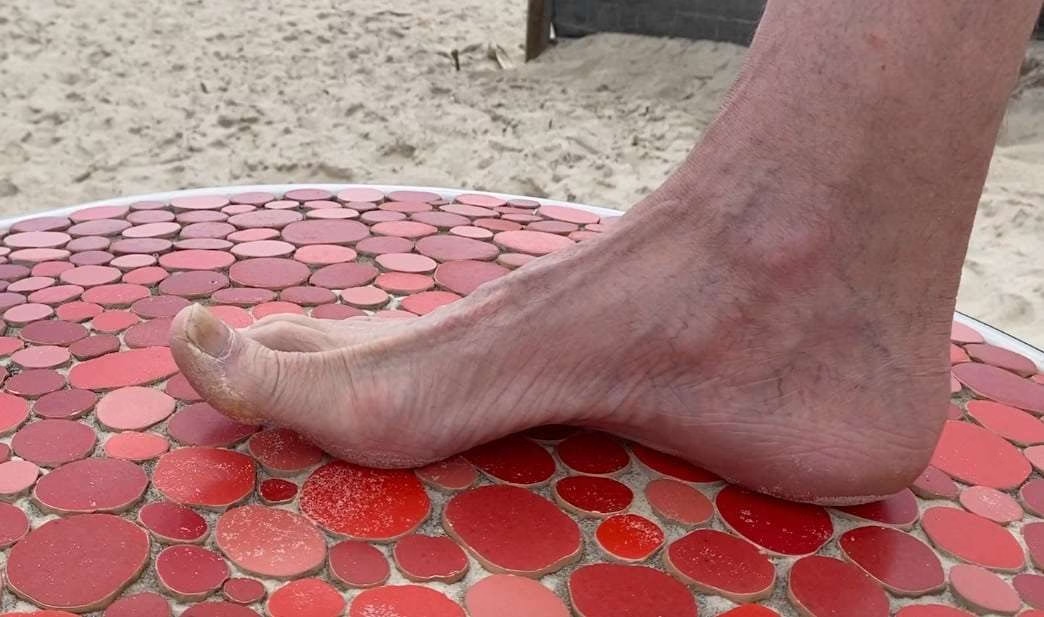
2. Big Toe Extensions
The second exercise is very easy and involves simply lifting the big toe up from the floor whilst keeping the lesser toes on the floor.
3. Pinkie Toe Extensions
Also an easy one, the third exercise involves simply raising the fifth or pinkie toe up from the floor whilst keeping the big toe on the floor.
Important information for the Intrinsic Muscle Exercise Program
Now the study asked their patients to do 104 of these repetitions daily, sounds like a lot, but the exercises are so simple that it only takes a few minutes each day to get them all done.
The following protocol was observed:
- For the first two weeks all exercises were performed whilst sitting down,
- For the 3rd and 4th weeks all exercises were performed with both feet on the floor,
- For the 5th and 6th weeks (final) all exercises were performed with only the affected foot on the floor.
Please ensure that you feel safe and secure whilst doing these exercises and that you are not at a risk of falling
Get Some Guidance From the Experts
This article is general in nature and is not a substitute for getting professional care. If you have an injury you should consult a podiatrist or a doctor.
Podiatrists are the primary health professionals of the lower limb and are very good at analysing your situation and goals, and know which pathways to put you on to get there.
If you need some help with your intrinsic muscle strength programme, whether it’s for chronic ankle instability, falls risk or getting better performance out of yourself, podiatrists have the experience and the expertise to guide you in the right direction.
Note: Affiliate links appear in this article and I may receive a small commission if you purchase through these links.