

Benign Joint Hypermobility Syndrome
Remember those kids who were really flexible at school? Maybe you were even one of them?
When I was at school they were called “double jointed.” They could do all these tricks like the splits, and bending their thumb back to touch their arm.
Turns out they (and you) MAY have Benign Joint Hypermobility Syndrome (BJHS), and may not.
Many people are more flexible than the average person but they don’t have BJHS.
Luckily there are specific criteria to determine whether or not a person has BJHS and these are used by doctors and podiatrists to help diagnose the condition.
Fortunately for those with the condition there are ways of controlling the pain that is often associated with it and podiatry treatment can be one of the keys.
In This Article
In this article I will discuss the following topics.
Click on a topic to jump to that section:
- Hypermobility vs BJHS,
- What Problems May Hypermobility Cause,
- Symptoms of Benign Joint Hypermobility Syndrome,
- What is NOT Benign Joint Hypermobility Syndrome,
- How is Benign Joint Hypermobility Diagnosed?
- Treatment of Benign Joint Hypermobility
Hypermobility vs BJHS
Many people are quite flexible but don’t have benign joint hypermobility syndrome.
They may still get some aches and pain from time to time but aren’t chronically affected by the condition.
What Problems May Benign Joint Hypermobility Syndrome Cause?
When someone has BJHS the ligaments, tendons, and fascia are more elastic than the average person.
Ligaments, tendons and fascia are what hold our joints together and allow us to move in a controlled manner.
People with hypermobility by definition have more mobile joints, therefore they are less able to resist gravity, meaning that it is harder to control their movements.
Very flat feet is a common presentation.
Our feet rely heavily on tension in the ligaments to hold up the arches.
Without this tension, gravity wins and the high point of the arch can even be weight-bearing in extreme cases.
This causes all kinds of problems with the lower limbs as the muscles need to work that much harder to control and move the feet and legs.
There has been some evidence that people with Ligament laxity are more prone to arthritis. To learn more about foot arthritis click here.
Flat feet cause internal rotation of the whole limb from the hips, through the thigh bones (femurs), the knees, shins, ankles and big toes.
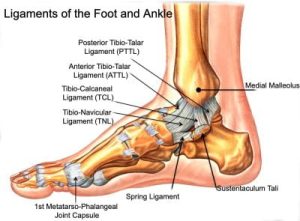
The illustration above demonstrates how crucial the ligaments are in maintaining the shape of the foot and ankle.
Symptoms of Benign Joint Hypermobility Syndrome
Because of the extra rotation that hypermobility in the lower limbs causes, there are many supporting structures: ligaments, muscles, tendons and fascia that are under increased load.
This can lead to several different aches and pains throughout the lower limbs and the lower back.
Some common complaints that we see are:
Severs Heel Pain (Calcaneal Apophysitis)
Severs Heel Pain – A growth plate issue which causes pain mainly in ages 9-14.
Sore Lower Legs (Shins)
Sore lower legs (shins) – this is one of the most common conditions that we see associated with hypermobility.
Because a lot of the muscles that control the feet and ankles are attached to the shin bone, this is a common source of pain.
Often misdiagnosed as Growing Pains this condition will often disturb sleep and makes children not feel like being very active.
Luckily it is one of the most receptive to treatment – custom inserts will remove a lot of the tension in the muscles and ease the pain.
To learn more about shin pain in children click here.
Sore Hips, Knees and Ankles
Without going into too much detail on each condition here, I’ll mention that all the major joints from the hips down can be affected by BJHS.
Internal rotation of all of these joints puts extra strain on the joint capsules, ligaments, muscles, and tendons.
In extreme cases the joints will be at their end range of motion (the furthest they can go in a particular direction).
To prevent further damage to cartilage in severe cases, it is important that you or your child is assessed to ensure the most appropriate treatment is applied.
Back Pain
All lower back pain should be investigated, especially in children.
If they have back pain it is important that the cause is determined so that the best treatment plan can be implemented.
Causes of back pain can range from simple muscles strains, to many more complex bony and joint conditions like spondylitis, spondylolisthesis and scoliosis.
What is NOT Benign Joint Hypermobility Syndrome
There are several more severe joint hypermobility conditions which rule out BJHS because they are not considered as benign.
If your child is very flexible AND has scarring of the skin and any other unusual signs, it is worth getting a paediatrician’s opinion to rule out other conditions.
These include:
- Marfans Syndrome – a potentially life-threatening disorder that affects the connective tissue of the eyes, skin, blood vessels and heart.
People with Marfans tend to have very long fingers (arachno-dactyly) and long faces.
If the aorta is affected, treatment is essential to avoid splitting which is usually fatal. There can also be problems associated with the heart valves. - Ehlers Danlos Syndrome (EDS) – “is a group of hereditary connective tissue disorders that manifests clinically with skin hyperelasticity, hypermobility of joints, atrophic scarring, and fragility of blood vessels.” (National Library of Medicine USA. May 28, 2023).
This condition is rare but more common than Marfans Syndrome and is not as severe in its effects.
I once referred a boy who could bend his third toe right back to touch the top of his foot – he was subsequently diagnosed with EDS by a paediatrician. - Osteogenesis Imperfecta (Brittle Bone Disease) – another genetic disease where children will break their bones very easily, sometimes without any obvious injury occurring.
Children will often be tested for Osteogensis Imperfecta because they have blue sclera – a common sign.
How is Benign Joint Hypermobility Diagnosed?
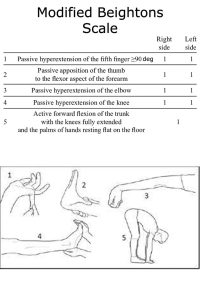
Two specific processes are used in conjunction to diagnose a person with BJHS – the Beighton’s Scale and The Brighton’s Criteria.
In the past people have used the beighton’s scale alone, but it was designed to be used with the Brighton’s Criteria.
The Modified Beightons Scale (below) gives you a number out of 9 which we then use with the Brightons Criteria (further below) to diagnose BJHS.
The Brighton’s Criteria
We now take the score from the Beightons Scale and use it in the Brightons Criteria to determine a diagnosis.
To have Benign Joint Hypermobility Syndrome a person must have either:
- 2 of the major criteria,
- 1 of the major and 2 of the minor criteria,
- 4 of the minor criteria.
Major Criteria
- Beightons score of 4/9 or greater (either currently or historically)
- Arthralgia (joint pain) for longer than 3 months in 4 or more joints.
Minor Criteria
- Beightons Score of 1-3,
- Arthralgia (joint pain) of greater than 3 months in 1-3 joints or back pain,
- Beighton score of 1-3
Arthralgia (> 3 months) in 1-3 joints or
back pain - > 3 months, spondylosis, spondylolysis or
spondylolisthesis - Dislocation/ subluxation in more than one joint, or in one
joint on more than one occasion. - Soft tissue rheumatism > 3 lesions (e.g. epicondylitis,
tenosynovitis, bursitis) - Marfanoid habitus (span: height ratio > 1.03 or upper
segment lower segment ratio < 0.89) - Abnormal skin: striae, hyperextensibility, papyraceous scars,
thin skin - Eye signs: drooping eyelids, myopia or antimongoloid slant
- Varicose veins, hernia, uterine/rectal proplase
Treatment of Benign Joint Hypermobility
Joint hypermobility is usually a genetic condition.
Whilst we can’t cure it, there are several types of treatment that we can do to ensure less pain for the patient.
Improving Muscle Strength
The job of muscles is to move the joints of our bodies in an effective and controlled manner.
As mentioned above, the job of the muscles is made harder by hypermobility, but the stronger and more effective we make the muscles, the less pain you will suffer.
We can prescribe specific exercises to help the muscles to become stronger, but also to improve muscle memory, so that they kick in at the right time and help to prevent problems.
Staying active and keeping a healthy weight is also a great way to ensure minimal issues from BJHS.
Custom Inserts – Orthotics
Another great way to prevent stress and strain on the tissues around hypermobile joints is to use custom shoe inserts or orthotics.
A custom orthotic is ordered from a lab by your podiatrist and is made from a 3D laser scan of your feet.
This ensures that we are able to assist the neural pathways which control your feet to minimise the amount of tension on ligaments, tendons, muscles and joint capsules.
To read more about custom orthotics click here.
Footwear Advice for People with Joint Hypermobility
Believe it or not footwear can make a huge difference in people with BJHS.
Shoes that are worn out, or that are not strong enough in the heel cup and upper, or that are not stiff enough in the sole will not support your feet the way they should.
Learn more about getting the right shoes to fit your feet here.
Disclaimer: The information contained in this article is general in nature and does not replace the need for professional advice and treatment. If you believe you or a family member have a foot or ankle problem, seek advice from a podiatrist or your family doctor.