Rafa Nadal Possesses Great Resilience
Rafael Nadal missed the Australian Open in 2024 but I thought I’d talk about his incredible resilience in the face of what should have been a career-ending injury.
At only 19 years old Rafael Nadal was diagnosed with Mueller Weiss Syndrome, a rare foot condition where the navicular bone (near the high point of your arch on the inside) is misshapen.
This caused him significant pain to the extent that a doctor told him his career was over.
Can you imagine that?
We never would’ve seen the brilliance of a player who has won 22 Grand Slam Titles including a record smashing 14 French Open Titles!
But Rafa is made of tougher stuff than that.
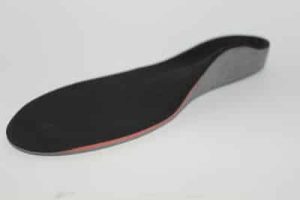
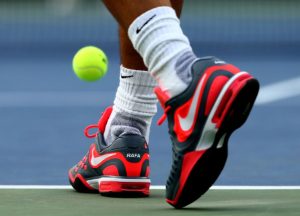
He worked with Nike and specialists to wedge his feet using custom foot orthotics and adaptations to his shoes to minimise the pain. Learn more about foot orthotics here.
He was told at the time that such extreme wedging could damage his knees and that he would have to have surgery as a young man.
Rafa obviously decided that the possibility (which he had already shown) of a glorious career was worth this risk.
What are the Causes of Mueller-Weiss Syndrome?
Being quite a rare condition there is not as much research on Mueller-Weiss are there are on many other foot conditions.
There have been studies conducted which suggest that one of the primary causes is excessive stress on a poorly ossified navicular bone.
Poorly ossified means that the bone is not hard enough to absorb a lot of repeated trauma – e.g. from playing a hell of a lot of tennis.
Some other possible causes of Mueller-Weiss Syndrome include:
- Osteonecrosis – death of bone,
- trauma or altered biomechanics (alignment of the bones and joints),
- Congenital defects
- Malnutrition.
Diagnosing Mueller-Weiss Syndrome.
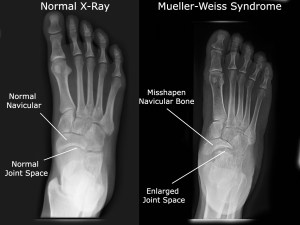
In the figure above we can see a comparison of a normal x-ray vs an x-ray of a foot of a person with Mueller-Weiss Syndrome. I do hate using the word “normal” as nobody is actually normal. Variance is what makes people interesting.
What you’ll notice on the right-hand photo is that the navicular bone has a different shape. It is more pointy on the right-hand side portion of it.
There is also a significantly larger gap in the joint space between the talus and the navicular which is pointed out in the photo.
This larger gap at the high point of the arch means that the arch is not well supported, regularly leading to a very flattened foot shape.
Treatment of Mueller-Weiss Syndrome.
The two most effective treatments for Mueller-Weiss syndrome are surgery and custom foot orthotics (shoe inserts).
This X-ray shows a foot which has had a triple arthrosdesis of the rearfoot and talo-cuneiform fusion.
You can see the screws and plates on the x-ray.
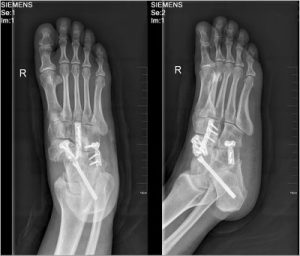
Credit: The Journal of Orthopaedic Surgery and Research. Jan 2017.
Custom orthotics are a conservative treatment which can be used either on their own, or following surgery such as the one above.
By supporting the arches of the feet they considerably reduce the stress going through the joints of the foot and lower limb especially those around the navicular when Mueller-Weiss syndrome is present.
This treatment can both reduce pain and slow down the progression to osteo-arthritis.
Some other treatment options used are:
- Anti-inflammatory medications (NSAIDs),
- Ankle Foot Orthosis (AFO) – an orthotic device that extends up the leg to just below the knee.
- Casting as a temporary option,
- Relative rest – reducing your activity by cutting out anything that isn’t absolutely necessary.
The Rafa Slide
One of the features of Nadal’s game is the freakish way that he can slide on clay surfaces.
As you can imagine sliding in all directions at such speed for hours upon hours puts incredible stress on ligaments, joint capsules, tendons and muscles of legs, knees, hips, ankles and feet. Including those around his Mueller-Weiss problem.
This worked for a long time, long enough to win nearly all of his titles to date.
Then in 2022 things started to catch up with our hero and his team had to take more drastic measures.
During the build up to his attempt to win a 14th French Open Title on clay, he was forced to pull out of the Rome Open due to his foot injury.
A Drastic Solution
The doctor suggested something very drastic to help him get through the pain caused by Mueller-Weiss syndrome.
Local anaesthetic injected into the area around his navicular bone to actually numb his foot and allow him to play through.
Local anaesthetics have been used in elite sport for years, the problem with them is that you are turning off pain, which is our natural protective mechanism.
Pain lets us know that something is wrong and that we need to stop what we’re doing to prevent more severe damage.
Without pain, we will continue placing more stress on damaged tissue and can cause much more extensive damage.
Rafa reported that his foot felt numb throughout the French Open.
His Record Breaking 14th French Open Win!
In the end he lifted The Musketeers Cup for the fourth time at Roland Garros.
Unfortunately these extreme measures have consequences.
This achievement cannot be understated as the nearest competitor is Novak Djokovic (most Grand Slam tournaments overall) with 10 wins at the Australian Open.
So Nadal stands clearly atop of the mountain with 14 wins at one Grand Slam tournament.
He has stated that he limps and experiences foot pain every day of his life due to Mueller-Weiss Syndrome.
That’s a high price to pay, but I doubt that he would have any regrets.
Important Note
Please note that we do not condone these extreme type of measures for treating conditions like Mueller-Weiss Syndrome.
Working with your body to get the most out of it is always the best policy.
Custom orthotics when prescribed appropriately are a very safe and effective treatment.
Disclaimer: The information contained in this article is general in nature and does not replace the need for professional advice and treatment. If you believe you or a family member have a foot or ankle problem, seek advice from a podiatrist or your family doctor.