
What is Arthritis in The Foot?
The word arthritis is a word with Latin roots. “Arthro” means “of the joint,” and “itis” means “inflammation.”
So it makes sense that arthritis is the name of the condition that affects the joints, causing pain and inflammation. Another important factor of arthritis is that it results in permanent damage to the joints.
Symptoms of arthritis in the foot and ankle include pain, swelling, stiffness, and difficulty walking.
In this post I will specifically discuss Osteo-Arthritis in the foot.
I will write about the other types including Rheumatoid, Psoriatic and sero-negative types in a future post.
What are the Different Types of Arthritis?
There are many types of arthritis and all of them cause inflammation, pain and degradation of the joints of the body.
The main five types that we tend to see in the feet and ankles are:
- Osteo-arthritis
- Rheumatoid Arthritis
- Psoriatic Arthritis
- Gouty Arthritis
- Ankylosing Spondylitis
Osteo Arthritis in The Foot
Osteo arthritis is most commonly caused by called repetitive stress, and is often referred to as a wear and tear type of disease.
It is also by far the most common type of arthritis that we see in the feet.
Knees, hips, ankles, toes and the mid-foot are classic areas of the body to be affected by osteoarthritis.
Repetitive stress is often caused by excessive activity, such as running, jumping. People who play high impact sports for years will often suffer with osteoarthritis.
In the lower limbs, repetitive stress is greatly increased if the person is over-weight.
Arthritis in the foot and ankle can also be caused by injury or ageing.
Injuries such as broken bones where the fractures crosses over the joint, will often lead to permanent damage of that joint and therefore arthritis.
Arthritis can also increase your falls risk.
Osteo arthritis on Top of The Foot
The area running across the top of the foot is a classic area for arthritis in the foot.
Called the mid-tarsal joint, it is particularly prone to a lot of stress as we walk millions of kilometres throughout our lives.
From repeated stress of the body weight every time you take a step, and several times your body weight if you are running or jumping.
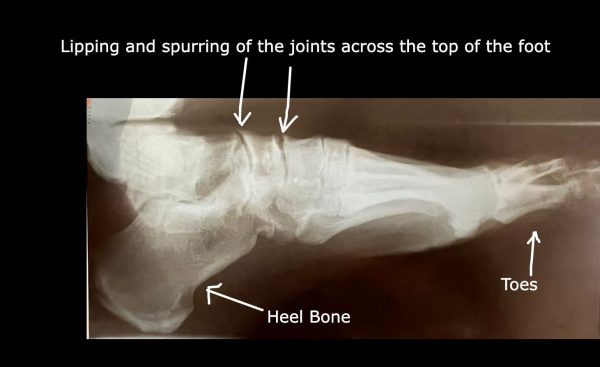
The below picture shows the small lips and spurs that form across the top of the mid-tarsal and the Lisfrancs joint from repeated stress.
When these lips become significant, the arch of the foot can no longer flex (by slightly collapsing) which is the natural shock absorbing system of the foot.
This has a couple of detrimental effects:
- Pain – as the lips and spurs are forced together by walking – pain results,
- Compensation – as the mid foot can no longer flex as well as it could, other joints such as the ankles, knees, or hips need to compensate, which in turn puts more stress on them.
Osteo-arthritis in the Big Toe – Hallux Limitus and Rigidus-
Another common spot for arthritis in the feet is where the big toe joins the foot (first Metatarsal-phalangeal joint or MPJ1).
Lipping and spurring can occur across the top of the joint causing a restriction in the amount of movement of the joint.
This joint is absolutely crucial for normal walking and running. The normal range of motion for the First Metatarsal Phalangeal joint is 70 degrees in an upward direction (dorsiflexion). As you can see in the diagram to the right.
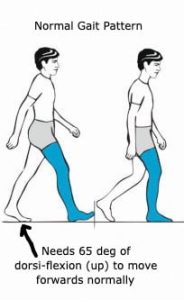
A reduction in the amount that the toe can move upwards is called Hallux Limitus and forces the person to compensate through other joints in order to move forwards.
Some people with advanced arthritic changes can have ZERO degrees of movement in this joint. This condition is called Hallux Rigidus and means that the normal mechanism of walking over your foot to go forwards is blocked and another compensation is required.
One of the most common compensations for this condition is to turn the foot outwards so that the person can roll over the middle of the foot. Another common compensation is to tip the foot outwards so that they can toe off through the smaller toes.
The problem with compensation is that it nearly always will cause pain and problems somewhere else in the body as another joint is forced to behave in a way outside it’s normal movement.
Osteo-Arthritis in the Ankle
The ankle can also be affected by osteo-arthritis leading to pain, a lack of movement and compensation.
The ankle is made up of three bones: the talus, which sits atop the heel bone, plus the tibia and fibula which are the two bones of the lower leg.
It is surrounded by a small amount of fluid that lubricates the joint and acts as a shock absorber.
In a normal ankle, the range of motion is usually a total of 65 to 75 degrees. Made up of 10-20 degrees of dorsi-flexion (upwards) and 40-55 degrees of plantar flexion (downwards).
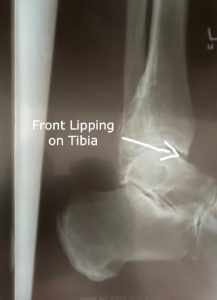
The X-ray to the right show a side on (lateral) view of an ankle and demonstrates the lipping which is occurring at the front of the tibia (leg bone).
This lipping reduces the amount of upwards movement available in the ankle which causes pain and dysfunction.
In the picture to the left you can see a man walking and the arrow points to where the flexion is needed in the ankle to allow the person to move forwards normally.
If there is less than 10 degrees of dorsiflexion, then the body needs to compensate in another area such as the knees, or hips or big toe joint to allow the person to walk. This compensation can lead to over use and wear and tear of other joints, which often results in pain.
Treatment of Osteo-arthritis in the Foot and Ankle
There are several treatments for osteo-arthritis which can be quite effective in reducing pain and discomfort in the short term. Whilst this is very important, it doesn’t do anything to treat the root cause and slow down the progression of the disease.
Custom Foot Orthotics:
Custom foot orthotics can improve pain by reducing the amount of stress going through a particular joint. A podiatrist can take a full assessment of your pain and your walking to prescribe you the correct custom foot orthotics.
Learn more about foot orthotics here.
Medications may include oral anti-inflammatory medications which include:
- Ibuprofen (such as Nurofen)
- naproxen (such as Naprosyn)
- diclofenac (such as Voltaren)
- celecoxib (such as Celebrex).
Some of these including diclofenac (Voltaren) can also be bought over the counter in a topical form (applied to the area – not oral).
N.B. before taking aby of the medications listed above, or any new medications, you must consult your medical practitioner.
Physiotherapists can also play a big part of your recovery by helping to strengthen the muscles that support the relevant joints and help you to adapt the way you do some activities to put less stress on arthritic joints.
Disclaimer: The information contained in this article is general in nature and does not replace the need for professional advice and treatment. If you believe you or a family member have a foot or ankle problem, seek advice from a podiatrist or your family doctor.